Diamond jewellery runs on an entirely different verification system from the gold hallmark covered elsewhere on our site, and a major regulatory change in January 2026 just made that system stricter and more transparent than it’s ever been.
This guide covers what actually matters when buying diamond jewellery: how certification works, what the 4Cs mean, the real difference between natural and lab-grown diamonds, and India’s new disclosure rules that every seller is now required to follow. For gold purity and hallmarking specifically, see our separate hallmark guide; this piece is entirely about diamonds.
Diamond Certification Isn’t the Same as a Gold Hallmark
It’s worth clearing up a common confusion first. BIS hallmarking, which we’ve covered in detail separately, certifies the purity of gold and silver through a national, government-run testing system. Diamonds are evaluated differently: independent gemological laboratories, not BIS, grade a diamond’s quality across four specific characteristics and issue a certificate describing what they found. The two systems exist side by side on a diamond-studded gold piece: the gold gets hallmarked, and the diamond gets separately certified.
BIS does have a role with diamonds, but it’s a narrower one: since January 2026, BIS regulates how diamonds are described and labelled, not their quality grade. That’s a genuinely new and important distinction worth understanding before you buy.
India’s New Diamond Disclosure Rule: What Changed in 2026
On 15 January 2026, BIS adopted IS 19469:2025, a new national standard adapted from the international ISO framework on consumer confidence in the diamond industry. The rule draws a hard line: the standalone word “diamond” can now only be used for natural, mined stones. A seller can add words like “natural,” “genuine,” or “precious” if they want to, but doesn’t have to, since the word “diamond” alone is now understood to mean natural.
Laboratory-grown stones face the opposite requirement. They must always be described using the full term “laboratory-grown diamond” or “laboratory-created diamond,” spelled out in full. Abbreviations like “LGD,” “lab-grown,” or “lab diamond” are no longer allowed on labels or certificates, and neither are softer, more ambiguous descriptors like “cultured,” “nature’s,” or “earth-friendly.” Misleading terms like “fake” or “artificial” are explicitly banned too, since lab-grown diamonds are chemically real diamonds, just grown differently, not imitations.
The new rule goes further still: sellers must now disclose how a lab-grown diamond was actually produced, whether through Chemical Vapour Deposition (CVD) or High Pressure High Temperature (HPHT) methods, along with any treatments applied afterward to improve colour or clarity. In practical terms, a proper diamond disclosure today should tell you not just what you’re buying, but exactly how it came to exist.
Natural vs Lab-Grown Diamonds: What’s Actually Different
Chemically and optically, a lab-grown diamond is a real diamond, made of the same carbon crystal structure as a natural one, and graded on the exact same 4Cs scale by the same gemological laboratories. The difference is origin, not authenticity: a natural diamond formed underground over an extremely long geological timescale, while a lab-grown diamond is produced in a controlled facility over a period of weeks. Under India’s new rules, that difference has to be stated plainly rather than implied or buried in fine print, which makes comparing the two, and choosing deliberately between them, considerably easier than it used to be.
The 4Cs: How Diamond Quality Is Actually Graded
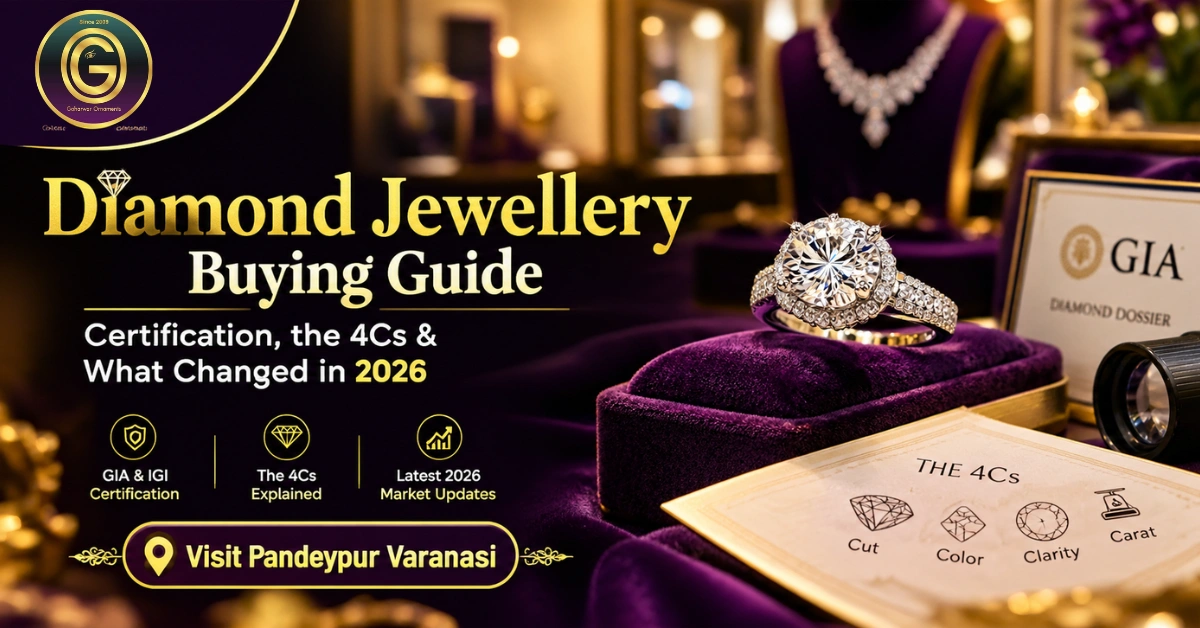
Every certified diamond, natural or lab-grown, is graded on four independent scales, together known as the 4Cs.
- Cut — how well the diamond’s angles and proportions are crafted, which determines how much light it reflects back as sparkle. Graded Excellent through Poor, this is generally considered the most important of the four for how a diamond actually looks.
- Colour — graded on a scale from D (completely colourless) to Z (visible yellow or brown tint). Most of these distinctions are invisible to an untrained eye, but they affect value meaningfully.
- Clarity — the presence of internal or surface characteristics, graded under 10x magnification, from Flawless down through various Included grades.
- Carat — the diamond’s weight, not its size directly, though the two are closely related.
None of the four Cs tells the full story alone. A larger diamond with a poor cut can look duller than a smaller, well-cut stone, which is why buyers are generally better off prioritising cut before stretching their budget toward a bigger carat weight.
Diamond jewellery runs on an entirely different verification system from the gold hallmark covered elsewhere on our site, and a major regulatory change in January 2026 just made that system stricter and more transparent than it’s ever been.
This guide covers what actually matters when buying diamond jewellery: how certification works, what the 4Cs mean, the real difference between natural and lab-grown diamonds, and India’s new disclosure rules that every seller is now required to follow. For gold purity and hallmarking specifically, see our separate hallmark guide; this piece is entirely about diamonds.
Diamond Certification Isn’t the Same as a Gold Hallmark
It’s worth clearing up a common confusion first. BIS hallmarking, which we’ve covered in detail separately, certifies the purity of gold and silver through a national, government-run testing system. Diamonds are evaluated differently: independent gemological laboratories, not BIS, grade a diamond’s quality across four specific characteristics and issue a certificate describing what they found. The two systems exist side by side on a diamond-studded gold piece: the gold gets hallmarked, and the diamond gets separately certified.
BIS does have a role with diamonds, but it’s a narrower one: since January 2026, BIS regulates how diamonds are described and labelled, not their quality grade. That’s a genuinely new and important distinction worth understanding before you buy.
India’s New Diamond Disclosure Rule: What Changed in 2026
On 15 January 2026, BIS adopted IS 19469:2025, a new national standard adapted from the international ISO framework on consumer confidence in the diamond industry. The rule draws a hard line: the standalone word “diamond” can now only be used for natural, mined stones. A seller can add words like “natural,” “genuine,” or “precious” if they want to, but doesn’t have to, since the word “diamond” alone is now understood to mean natural.
Laboratory-grown stones face the opposite requirement. They must always be described using the full term “laboratory-grown diamond” or “laboratory-created diamond,” spelled out in full. Abbreviations like “LGD,” “lab-grown,” or “lab diamond” are no longer allowed on labels or certificates, and neither are softer, more ambiguous descriptors like “cultured,” “nature’s,” or “earth-friendly.” Misleading terms like “fake” or “artificial” are explicitly banned too, since lab-grown diamonds are chemically real diamonds, just grown differently, not imitations.
The new rule goes further still: sellers must now disclose how a lab-grown diamond was actually produced, whether through Chemical Vapour Deposition (CVD) or High Pressure High Temperature (HPHT) methods, along with any treatments applied afterward to improve colour or clarity. In practical terms, a proper diamond disclosure today should tell you not just what you’re buying, but exactly how it came to exist.
Natural vs Lab-Grown Diamonds: What’s Actually Different
Chemically and optically, a lab-grown diamond is a real diamond, made of the same carbon crystal structure as a natural one, and graded on the exact same 4Cs scale by the same gemological laboratories. The difference is origin, not authenticity: a natural diamond formed underground over an extremely long geological timescale, while a lab-grown diamond is produced in a controlled facility over a period of weeks. Under India’s new rules, that difference has to be stated plainly rather than implied or buried in fine print, which makes comparing the two, and choosing deliberately between them, considerably easier than it used to be.
The 4Cs: How Diamond Quality Is Actually Graded
Every certified diamond, natural or lab-grown, is graded on four independent scales, together known as the 4Cs.
- Cut — how well the diamond’s angles and proportions are crafted, which determines how much light it reflects back as sparkle. Graded Excellent through Poor, this is generally considered the most important of the four for how a diamond actually looks.
- Colour — graded on a scale from D (completely colourless) to Z (visible yellow or brown tint). Most of these distinctions are invisible to an untrained eye, but they affect value meaningfully.
- Clarity — the presence of internal or surface characteristics, graded under 10x magnification, from Flawless down through various Included grades.
- Carat — the diamond’s weight, not its size directly, though the two are closely related.
None of the four Cs tells the full story alone. A larger diamond with a poor cut can look duller than a smaller, well-cut stone, which is why buyers are generally better off prioritising cut before stretching their budget toward a bigger carat weight.
Frequently Asked Questions
What changed in India’s diamond rules in 2026?
BIS adopted IS 19469:2025 on 15 January 2026, restricting the standalone word “diamond” to natural stones only. Lab-grown diamonds must now be described in full as “laboratory-grown diamond” or “laboratory-created diamond,” with abbreviations and misleading terms banned.
Is a lab-grown diamond a fake diamond?
No. A lab-grown diamond has the same chemical structure and is graded on the same 4Cs scale as a natural diamond; the difference is origin, not authenticity, which is exactly why misleading terms like “fake” are now banned under the 2026 disclosure rules.
What are the 4Cs of diamond grading?
Cut, colour, clarity, and carat. Together they determine a diamond’s overall quality and value, with cut generally considered to have the biggest visible impact on how a diamond actually sparkles.
Is IGI or GIA certification better?
Both are legitimate, internationally recognised laboratories. IGI is more commonly seen at Indian retail; GIA is considered the global benchmark the grading system was built around. Neither is untrustworthy compared to the other.
Does BIS hallmark diamonds the same way it hallmarks gold?
No. BIS hallmarks certify gold and silver purity. Diamonds are graded separately by gemological labs like GIA or IGI; BIS’s diamond-specific role, as of 2026, covers terminology and disclosure rules, not quality grading.
The Bottom Line
Diamond jewellery now comes with more clarity than ever, not less: certified 4C grades from an independent lab, and since January 2026, a legal requirement that natural and laboratory-grown stones be labelled plainly and correctly. Buying well comes down to insisting on both, a proper certificate and honest disclosure, on top of the same hallmark standard that applies to the gold around the stone.
Visit Gaharwar Ornaments on Police Line Road, Pandeypur, or call +91-9451098882 to discuss a custom diamond piece.