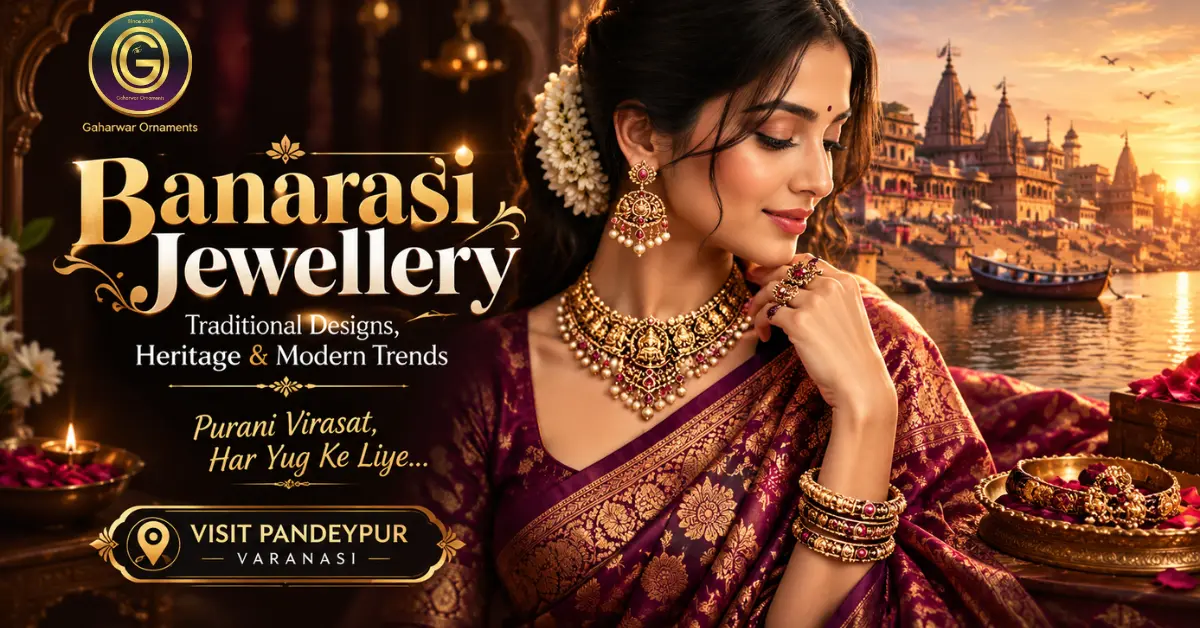
Banarasi jewellery isn’t a marketing label — it describes a genuine, centuries-old craft tradition rooted in Varanasi’s history as one of India’s oldest continuously inhabited trading cities. Understanding what actually makes jewellery ‘Banarasi,’ beyond simply being sold in the city, means understanding a specific craft, Gulabi Meenakari, and a broader goldsmithing legacy that produced pieces now held in the National Museum.
This guide traces that heritage: the techniques that define traditional jewellery in Varanasi, the motifs and design forms that have carried through generations, and how that heritage is being reinterpreted in handmade jewellery in Varanasi today without losing what made it distinctive in the first place.
A City Built on Craft: Varanasi’s Metalworking Heritage
Varanasi’s reputation as a craft city rarely starts with jewellery — Banarasi silk sarees, granted a GI tag in 2009, tend to get the spotlight first. But the same city that turned silk-weaving into a centuries-long tradition also built a serious metalworking economy alongside it, spanning brasswork, metal relief work, and fine jewellery making. Varanasi holds Geographical Indication tags for a genuine cluster of traditional crafts: Banaras Brocades and Sarees, Banaras Gulabi Meenakari, Banaras Metal Repousse Craft, Varanasi Wooden Lacquerware and Toys, and Varanasi Glass Beads among them — a level of protected craft density few Indian cities can claim.
Jewellery specifically grew out of this ecosystem. Historical records place Varanasi as an important centre of fine handcrafted jewellery making by the nineteenth and twentieth centuries, with goldsmiths working in techniques including kundan-setting and the city’s own distinctive enamel work. That lines up with Varanasi’s broader identity as one of India’s oldest gold and silver trading centres, a history we touch on in our guide to choosing a trusted jeweller in Varanasi — but the craft angle is what makes ‘Banarasi jewellery’ a specific, describable style, not just jewellery that happens to be sold locally.
Gulabi Meenakari: The GI-Tagged Craft at the Heart of Banarasi Jewellery
If one craft is most responsible for Varanasi’s jewellery-making reputation, it’s Gulabi Meenakari, literally “pink enamelling” — a technique of applying coloured enamel to metal that received its own Geographical Indication tag in 2015, formally recognising it as a craft that can only genuinely originate from Banaras.
The technique traces back to Persian enamelling traditions, refined in Isfahan under Qajar patronage, and reached Banaras through Mughal-era craftsmen and travelling traders. Over roughly two centuries, local artisans reworked it into something distinct from the enamelling styles practised elsewhere under Mughal patronage, different in both execution and visual character. The process starts with an artisan hand-drawing detailed patterns onto a metal surface, usually gold, silver, brass, or copper, before coloured enamel is applied and fired into those patterns, most often built around nature, mythology, and religious symbolism — lotus flowers, peacocks, and paisleys recur throughout.
One practical distinction is worth knowing if you’re evaluating a piece: meenakari applied only to the front is more affordable and far more common today, while work on both the front and back is considerably more intricate, more time-intensive, and priced accordingly. Neither is more “authentic” than the other — it’s a genuine trade-off between detail and cost that’s been part of the craft’s practical reality for decades, not a shortcut that compromises the technique.
Kundan Work and Banaras’s Jewellery-Making Legacy
Alongside meenakari, Banaras jewellers historically worked extensively in kundan, a traditional setting technique using refined gold foil to hold polished stones or glass in place without conventional prong-setting. The two techniques were often combined on a single piece: kundan-set stonework on the front, gulabi meena enamelling on the reverse, a pairing distinctive enough that surviving examples from Banaras workshops are held in the National Museum’s jewellery collection today, alongside a rare surviving album of nineteenth and twentieth-century Banaras jewellery design sketches.
Those museum pieces matter for more than historical interest. They’re physical proof that Varanasi’s jewellery-making tradition wasn’t a minor regional craft — it produced work considered significant enough to preserve at a national level, made by workshops whose techniques are still, in modified form, practised in the city today.
Traditional Design Motifs in Banarasi Jewellery
Design language in traditional jewellery in Varanasi draws heavily on the same symbolic vocabulary found across the city’s other crafts and its religious identity. Lotus motifs, associated with purity and spiritual significance, appear repeatedly across meenakari and kundan work alike. Peacocks, paisleys, and floral vine patterns echo motifs found in Banarasi silk weaving too, suggesting the city’s textile and jewellery traditions developed in visual conversation with each other rather than in isolation from one another.
Historical Jewellery Forms Unique to Banaras
Some historical Banaras pieces reveal just how elaborate the tradition could get. The baddhi, for instance, was an ornate cross-belt style ornament worn across the torso — a single statement piece, not a set, designed to be the visual centrepiece of an outfit rather than a supporting accent. Pieces like this represent the more ceremonial, opulent end of what nineteenth and twentieth-century Banaras workshops were capable of producing. Few jewellers make anything quite this elaborate today, but the same underlying kundan and meenakari techniques that made the baddhi possible are exactly what still define handmade jewellery in Varanasi now, simply applied to more wearable, contemporary forms.
How Handmade Jewellery in Varanasi Carries These Techniques Forward
Meenakari and kundan work remain genuinely hand-done, not machine-replicated, which is precisely why handmade jewellery in Varanasi carrying these techniques takes noticeably longer to produce and costs more in making charges than a machine-cast piece of equivalent weight. An artisan hand-draws each pattern before enamel work begins; no two pieces, even from the same design template, are perfectly identical the way machine-stamped jewellery is.
That’s worth knowing specifically because it’s invisible in a photograph. Two necklaces can look similar online while one took an artisan days of hand enamelling and the other took a machine minutes — the making-charge difference reflects that gap in labour, not an arbitrary markup. For the fuller breakdown of how making charges work generally, see our gold jewellery buying guide.
Modern Trends: Heritage Meets Contemporary Design
Heritage craft in Varanasi hasn’t stood still. The clearest modern trend is meenakari and kundan work scaled down onto lightweight, daily-wearable pieces, a single meenakari pendant or a pair of small kundan studs, rather than the full, heavy ceremonial sets historically associated with these techniques. That mirrors the broader move toward lightweight gold jewellery generally, but with a heritage technique layered onto it rather than a plain finish.
Colour palettes have broadened too. Gulabi Meenakari’s traditional pink remains its signature, but contemporary pieces increasingly pair it with blues, greens, and white enamel work on the same base techniques, aimed at buyers who want the craftsmanship without being limited to one colour story. None of this changes the underlying technique — it’s still hand-drawn, hand-enamelled work — it simply broadens what can be made with it. Heritage motifs are also turning up in bridal jewellery in updated form, layered alongside more contemporary necklace styles rather than replacing them.
Why Heritage Craftsmanship Still Matters When You Buy
The GI tag on Gulabi Meenakari exists for a specific reason: to protect a genuine craft from being diluted by cheap, mass-produced imitations sold under the same name. That protection matters commercially, not just culturally. Rising gold and silver prices, combined with a growing supply of cheaper, fibre-based imitations styled to look like meenakari, have put real pressure on artisans working in the genuine technique over the past decade. Buying knowingly from a jeweller who can speak specifically to how a piece was made, not just what it’s called, is a small but real way to support that craft continuing, rather than let it fade the way some smaller regional crafts already have.
The same verification instinct covered in our guide to choosing a trusted jeweller in Varanasi applies here: ask directly whether a piece is hand-enamelled or printed and stamped to imitate the look, and treat a jeweller’s willingness to explain the difference as a trust signal in its own right.
Banarasi Jewellery at Gaharwar Ornaments
Gaharwar Ornaments’ custom and same-to-same replication work regularly draws on these same traditional techniques, alongside the lightweight, contemporary collections sourced from jewellery hubs including Delhi, Mumbai, Kolkata, Coimbatore, and Amritsar. Every piece, whether it carries traditional meenakari work or a plain modern finish, is BIS hallmarked and billed transparently, so heritage craftsmanship never comes at the cost of certified purity.
Frequently Asked Questions
What makes jewellery genuinely ‘Banarasi’?
Traditionally, it refers to jewellery made in Varanasi using the city’s specific craft techniques, chiefly Gulabi Meenakari, a GI-tagged pink enamelling craft, often combined with kundan stone-setting, both practised locally for centuries.
Is Gulabi Meenakari only used on jewellery?
No. It’s applied to gold, silver, brass, and copper more broadly, but jewellery, particularly necklaces, pendants, and earrings, is one of its most common and recognisable applications.
What’s the difference between front-only and front-and-back meenakari?
Front-only enamelling is more affordable and common today; enamelling worked on both sides of a piece is more intricate, takes longer, and costs more, without either being more “authentic.”
Is handmade jewellery in Varanasi more expensive than machine-made pieces?
Generally yes, for pieces genuinely using hand techniques like meenakari or kundan-setting, because the making charges reflect real additional labour time, not just branding.
How can I tell if a piece is genuinely hand-enamelled?
Ask the jeweller directly, and look closely for small natural variations in the enamel work — genuine hand-applied meenakari is rarely perfectly uniform the way a printed or stamped imitation is.
Does a GI tag guarantee a piece of meenakari jewellery is authentic?
A GI tag protects the craft’s name and origin at a regional level rather than certifying each individual piece, so it’s still worth asking your jeweller directly how a specific item was made, the same way you’d verify a BIS hallmark on the gold itself.
The Bottom Line
Banarasi jewellery earns its name from a specific, GI-protected craft heritage, not just its city of origin: Gulabi Meenakari’s pink enamelling, historic kundan work, and motifs that echo the same lotus and peacock imagery found across Varanasi’s other crafts. That heritage is still very much alive in handmade jewellery in Varanasi today, increasingly reworked into lighter, more wearable modern pieces without losing the hand-craftsmanship that defines it.
See this heritage applied firsthand at Gaharwar Ornaments on Police Line Road, Pandeypur, or call +91-9451098882 to discuss a custom piece.